Electric Light Goods Vehicles in Delhi-NCR: Battery Planning Before the Mandate
Delhi-NCR fleet owners are watching electric light goods vehicles more seriously because policy, fuel costs, and urban air-quality pressure are all moving in the same direction. The NITI Aayog report, published in August 2025, describes India’s electric mobility push as linked to petroleum import concerns, city air pollution, and greenhouse gas reduction. For a small goods-vehicle operator, that makes battery planning a business decision, not only a vehicle purchase decision.
The useful question is not simply, “Which electric vehicle should I buy?” It is, “Can this battery support my route, charging window, replacement plan, and daily reliability?” A lithium battery for electric goods vehicle use has to work through traffic, loading variation, heat, missed charging opportunities, and driver habits. This article explains the planning points before a mandate, tender condition, customer requirement, or internal fleet target forces a rushed purchase.
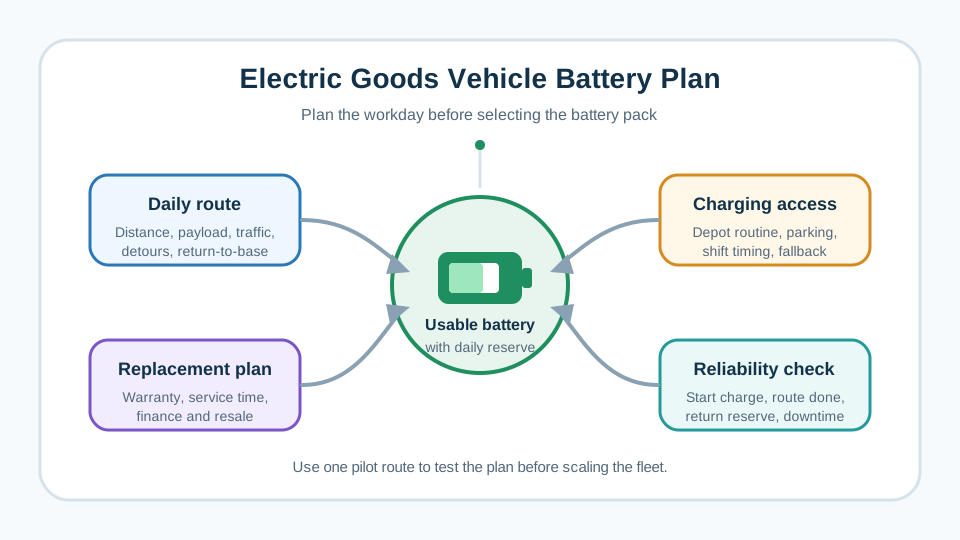
Daily routes and battery sizing
Battery sizing should begin with the actual duty cycle of the vehicle. A light goods vehicle that runs a fixed wholesale-market route has a different battery need from one doing multiple scattered delivery drops across Delhi, Noida, Gurugram, Ghaziabad, and Faridabad. The important planning input is the distance that must be completed reliably on a normal working day, with a practical reserve for detours, traffic, loading delays, and return-to-base movement.
Fleet owners should avoid planning only around the advertised range of a vehicle. Range can vary with payload, traffic speed, driving style, air-conditioning or auxiliary load, road conditions, and battery condition over time. The MDPI review page retained for this article discusses electric-vehicle benefits, challenges, and potential in broad terms, which supports the practical point that EV performance depends on system-level conditions rather than a single specification line.
A simple route audit can help before choosing an electric light goods vehicle battery. List the vehicle’s start point, delivery clusters, common waiting points, end point, and any emergency diversion route. Then compare the daily requirement with the usable battery capacity offered by the vehicle or battery supplier. The safest commercial plan is one where the vehicle can finish the day without depending on uncertain mid-route charging.
Charging access across Delhi-NCR operations
Charging access is as important as battery capacity. A vehicle with a larger battery but no reliable overnight charging may be less useful than a vehicle with a moderate battery and dependable charging at the depot. Delhi-NCR operations often cross municipal and state boundaries, so a fleet owner should think in terms of real parking locations, driver shift timing, loading-yard access, and electricity availability rather than only public charger visibility.
For small fleets, the first charging question is usually operational: where will the vehicle stand long enough to charge without disturbing loading, unloading, or driver rest? Depot charging is easier to control, but it requires safe electrical infrastructure and a routine that drivers actually follow. Public or third-party charging may help in emergencies, but it should not be the only plan for a goods vehicle that has committed delivery slots.
Charging planning should also include who is responsible when the routine breaks. If a driver returns late, if a loading bay is blocked, or if a charger is unavailable, the next day’s work can start with an undercharged battery. That creates a reliability problem even when the vehicle itself is mechanically sound. Battery planning therefore needs a charging checklist, not just a charger purchase.
Lithium battery readiness for goods vehicles
Lithium battery readiness means understanding the battery as a working asset. It is not only a pack fitted inside the vehicle; it is the part that decides range, charging time, replacement exposure, and resale discussions. Buyers should ask for clear information on chemistry, usable capacity, warranty terms, service support, thermal protection, charging recommendations, and what operating conditions can affect warranty coverage.
The PRS policy brief retained for this article is an electric-vehicle policy source, and the NITI Aayog report gives national context for electric mobility. These sources support the wider direction of EV adoption, but they do not replace product-level due diligence. A fleet buyer still needs written confirmation from the vehicle maker, battery supplier, or finance partner before treating any performance promise as commercially binding.
Delhi-NCR operators should also consider whether their team is ready to manage lithium-battery discipline. Drivers may need training on charging timing, warning indicators, safe parking, and reporting unusual behavior early. Supervisors may need a daily battery log that records start charge, end charge, route completed, and any charging issue. This basic recordkeeping helps separate a vehicle problem from a route-planning or charging-routine problem.
Replacement planning and lifecycle costs
Battery replacement planning should be part of the purchase discussion from the beginning. The battery is a major value component in an electric goods vehicle, so the owner should understand expected replacement conditions, warranty limits, service process, and downtime risk. Even if replacement is not immediate, the financial plan should not treat the first battery as if it will remain equally useful forever.
The lifecycle question is wider than purchase price. A fleet owner should compare acquisition cost, charging infrastructure, maintenance expectations, downtime, financing terms, battery warranty, and eventual replacement or resale assumptions. The NITI Aayog report frames electric mobility as a major national opportunity, but at the operator level the opportunity is only real if lifecycle cost is planned in advance and not discovered after the vehicle enters service.
Replacement planning also helps during financing discussions. If the loan period, warranty period, and expected operating life do not align, the owner may face a cost gap later. Before buying, ask what happens if battery performance declines, how a claim is assessed, where the vehicle must go for service, and how long the vehicle may remain off the road. These questions are practical, not pessimistic.
Operating reliability before fleet expansion
The first electric light goods vehicle should be treated as a pilot, even if the business intends to scale. Use it on a route where distance, loading, parking, and charging can be observed closely. The goal is to learn whether the battery plan supports the workday without heroic adjustments. If the first vehicle needs constant exception handling, adding more vehicles will multiply the same problem.
Reliability should be measured in daily operating terms. Did the vehicle leave on time? Did it complete the route? Did it return with a useful reserve? Was charging completed before the next shift? Were drivers confident in the vehicle? These questions are more useful for a small fleet than a broad industry claim, because they connect the electric vehicle battery directly to revenue movement and customer commitments.
Delhi-NCR fleets should also review route clustering before expansion. Electric goods vehicles can work better when deliveries are grouped intelligently and charging is planned around predictable idle time. If routes are scattered, payload is inconsistent, and return times are uncertain, battery planning needs more caution. The battery should not be forced to compensate for a weak operating design.
Decision bullets
- Map daily routes before selecting battery size, especially where the vehicle crosses Delhi, Noida, Gurugram, Ghaziabad, or Faridabad.
- Prefer a charging plan that the fleet controls, rather than depending only on uncertain mid-route charging.
- Ask for written battery warranty, service, replacement, and operating-condition details before purchase.
- Pilot one vehicle on a known route before expanding to a larger electric light goods vehicle fleet.
- Track start charge, end charge, route completion, charging issues, and downtime to improve future battery decisions.
For iTarang’s Delhi-NCR customers, the battery decision should sit at the center of electric goods-vehicle planning. The retained sources support the broader EV direction, while the buyer’s own route data confirms whether a specific vehicle and battery pack can do the job. A clear plan reduces the risk of buying too little battery, overpaying for unused capacity, or building a fleet around weak charging access.
Sources used for this article were accessed on 2026-08-21. Publication dates were unavailable for the MDPI page, AP page, and PRS page in the retained research brief; the NITI Aayog report states August 2025 in the retained text. Product-specific range, warranty, price, charger capacity, and replacement-cost claims require confirmation from the relevant vehicle maker, battery supplier, financier, or service partner before publication as purchase advice.