E-Rickshaw Battery Repair or Replacement: How Drivers Can Judge the Real Cost
An Lithium battery does not usually fail in one dramatic moment. For many users across mobility, the problem begins with shorter range, slower pickup, longer charging time, or the vehicle stopping earlier than expected during the working day. The first question is natural: should the battery be repaired, or is it time to replace it? The answer should not depend only on the workshop bill shown today.
The real cost includes the repair amount, lost earning days, repeated workshop visits, safety risk, and whether the battery can still support daily routes. Three wheelers are critical for micro and mid mile mobility in rural and urban India alike, and CBC reported that their number was nearing two million in 2022. In such a large working market, a weak battery is not just a technical issue. It is a daily income issue.
Start with the warning signs
The first warning sign is reduced range on the same route, with the same load, and under similar driving conditions. If the vehicle earlier completed a full shift but now needs charging before the day ends, the battery deserves attention. Another warning sign is a sudden voltage drop under load, where the vehicle starts normally but struggles when passengers, slope, or traffic pressure increases.
Charging behaviour also matters. A battery that takes unusually long to charge, becomes hot during charging, or loses charge quickly after a full charge may not be healthy. Drivers should also watch for swelling, leakage, smell, loose terminals, corrosion, or repeated charger cut-off. These signs should not be ignored, because battery condition affects performance, uptime, and safety.
For fleets, the warning signs are often visible in records before they are visible in one vehicle. If the same battery keeps coming back for service, if one vehicle earns fewer working days than similar vehicles, or if drivers complain about unreliable backup, the decision should move from “can it be patched?” to “is this asset still dependable?”
Compare the bill with the working value
The simplest rule of thumb is to compare repair cost with the working value left in the battery. Do not ask only, “Is repair cheaper than replacement?” Ask, “After repair, will this battery reliably earn enough working days to justify the repair?” A small bill can be expensive if it leads to repeated downtime. A larger replacement can be cheaper if it restores predictable daily earning capacity.
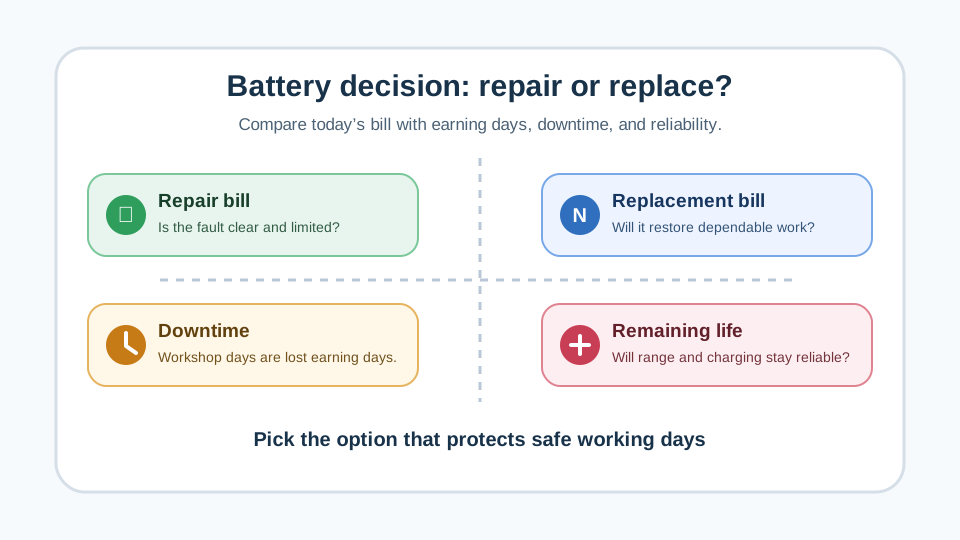
A useful comparison has four parts: the repair quote, the replacement quote, the expected usable life after repair, and the earning days lost during diagnosis and service. If the repair fixes one clear issue and the battery is otherwise stable, repair may be sensible. If the problem is repeated, unclear, or linked to weak cells across the pack, replacement becomes easier to justify.
This is especially important because the 3W battery market includes both lead-acid and lithium-ion batteries, and market research pages from P&S Intelligence and MarkNtel Advisors both classify the India e-rickshaw battery market by battery type and capacity. The right decision may differ by chemistry, age, usage, and service history. A driver should therefore compare options using the actual battery in hand, not a general market assumption.
When repair is still sensible
Repair can make sense when the issue is specific, visible, and limited. Examples include a loose connection, damaged cable, terminal corrosion, charger-side issue, or an imbalance that a qualified technician can diagnose clearly. In such cases, the battery may still have useful working life left, and replacing the full pack immediately may waste money.
Repair is also more sensible when the battery has not shown a long pattern of failure. If the vehicle was performing normally and one fault appeared suddenly, a proper inspection may protect the driver from unnecessary replacement. The key is diagnosis. A repair decision based only on a low quote is weak; a repair decision based on a clear fault report is stronger.
Fleet owners should standardise this decision. Each workshop visit should record the complaint, diagnosis, parts changed, downtime, and result after repair. The EV Care maintenance guide describes the gap between a well-maintained e-rickshaw and a neglected one as the difference between earning days and workshop idle time. That is the correct lens: repair is good only if it protects earning days.
When replacement is the safer long-term choice
Replacement becomes the safer choice when the battery is no longer predictable. If range keeps falling after repair, if the same fault returns, if charging time increases without stable backup, or if the vehicle cannot complete normal duty cycles, the driver is carrying business risk. At that point, the repair bill is only one part of the loss.
Safety signs should push the decision faster. Swelling, leakage, burning smell, unusual heating, or damaged casing should be treated seriously and checked by a qualified technician. A driver should not keep using a battery just because it still moves the vehicle for a short distance. A weak battery can create operational risk for the driver, passengers, and workshop staff.
Replacement is also easier to justify when the driver needs reliability for fixed routes, school trips, market timing, or fleet commitments. If one vehicle’s battery uncertainty affects customer trust, daily collection, or repayment discipline, the “cheaper” repair may not be cheaper at all. For financed vehicles, predictable performance is part of the asset’s value, not an optional comfort.
Closing: think beyond today’s cash bill
The best repair-or-replace decision is practical, not emotional. Repair is sensible when it restores dependable earning capacity at a reasonable total cost. Replacement is sensible when it removes repeated uncertainty and gives the driver a stronger base for daily work. The bill amount matters, but the better question is whether the battery can still do the job safely and reliably.
For iTarang, this topic fits the wider battery lifecycle view shown on its own pages: finance, deploy, monitor, maintain, buyback, and recycle. Existing iTarang blog coverage also discusses battery lifecycle records through the battery passport concept.