Why India Is a Strong Use Case for Battery-as-a-Service in Electric Mobility
India is not just another EV market. Its strongest early electric-mobility use cases are practical, high-utilisation vehicles that move people and goods through dense urban routes every day. E-rickshaws and light electric vehicles are especially relevant because the battery is not an abstract technology choice. It directly affects uptime, driver income, lender risk, dealer confidence, and the useful life of the vehicle.
Battery-as-a-Service, or BaaS, fits this context because it separates battery access from outright battery ownership. Instead of making every driver or small operator buy, maintain, replace, and dispose of a costly battery alone, a service model can package access, financing, monitoring, maintenance, recovery, buyback, and recycling into a managed lifecycle. That is why the question is not only whether India needs more EVs. It is whether India needs better battery ownership models.
This article focuses on e-rickshaws and light electric vehicles, not passenger cars. The business case is different: these vehicles earn money through daily use, often operate in crowded urban areas, and serve customers who may not have reliable private charging. Those conditions make India a strong use case for EV battery service India models, especially where financing and lifecycle control are built together.
Why India’s urban EV use case points toward service models
India’s electric-mobility push is tied to practical national concerns: petroleum import dependence, urban air pollution, and transport-sector emissions, as described in NITI Aayog’s Electric Vehicles in India report. Those goals are broad, but the first-mile and last-mile use cases are very specific. E-rickshaws and light EVs work in dense routes where vehicle downtime is expensive and battery failure is not just a technical issue.
Dense urban use changes how a battery should be evaluated. A privately owned battery may look simple at the point of sale, but it puts the driver in charge of charging discipline, maintenance decisions, replacement timing, and end-of-life handling. In a daily-earning vehicle, each of those decisions has business consequences. If the battery degrades early, the driver loses earning hours and the lender loses confidence in the asset.
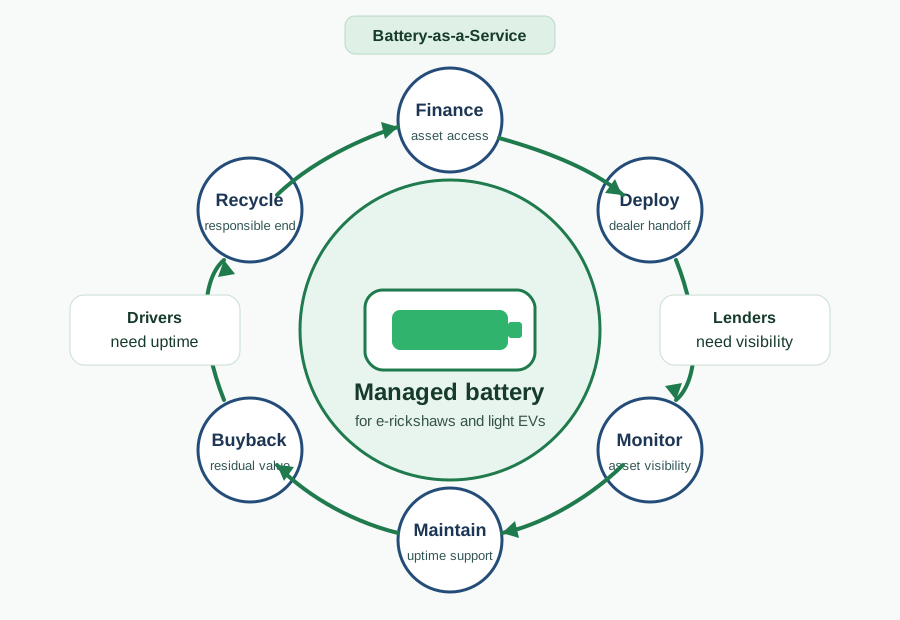
This is where battery as a service India models become useful. A service provider can treat the battery as a managed asset rather than a one-time sale. That does not automatically solve every problem, but it creates a structure where performance, payments, maintenance, and eventual recovery can be designed together. For a market with many small operators, that structure matters.
Limited home charging makes managed battery access more relevant
For many commercial light-EV users, home charging is hard to execute. Drivers may live in rented housing, shared spaces, informal settlements, or buildings without a safe dedicated charging point. Even with electricity access, overnight charging may be unreliable, inconvenient, or mismatched to the vehicle’s earning schedule.
Research on EV adoption barriers consistently points to charging access, cost, and user confidence as adoption factors. The retained ScienceDirect and MDPI sources discuss EV barriers and motivators generally, while PRS frames charging infrastructure and policy as part of India’s EV transition. For e-rickshaw drivers, these issues are practical: difficult charging makes the battery the operating bottleneck.
A Battery-as-a-Service model can reduce that bottleneck when designed around the driver’s routine. Depending on the operator model, this may mean financed battery access, monitored charging behaviour, planned maintenance, service support, or battery replacement pathways. The core idea: drivers should not become battery-risk managers to keep earning.
BaaS should not mean only “battery swapping.” Swapping can be one service design, but EV battery service India models are broader. For e-rickshaws and light EVs, the question is whether the battery is financed, monitored, maintained, recovered, and responsibly moved to its next stage. That lifecycle view strengthens the Indian use case.
Why financing is central to the BaaS case
Battery cost is a clear reason BaaS matters. When a driver cannot buy a high-quality battery upfront, the market often shifts toward informal finance or lower-quality choices. iTarang’s investor page states that 90% of e-rickshaw batteries are financed informally and drivers pay 30–60% interest. Treat these as iTarang-stated, company-positioned evidence unless independently verified.
The problem is easy to understand. A battery is a productive asset, but also a credit-risk asset. If lenders cannot see post-disbursement use, they may price risk higher, avoid the segment, or depend on informal channels. Drivers then pay more, choose cheaper batteries, or delay replacement, weakening the battery ecosystem.
A managed battery service can improve this logic. If the battery is tracked, maintained, and recoverable, the lender has better asset visibility. If the driver pays through a structured daily or periodic model, the battery better matches income. If the dealer can offer financing without carrying credit risk alone, sales can become more consistent.
This is why the best publishing category is financing. The article mentions charging, maintenance, and recycling, but the main reader decision is financial: whether battery ownership should be separated from battery access for high-use commercial EVs. For iTarang, that connects directly to its stated platform focus on finance, deployment, monitoring, maintenance, buyback, and recycling.
Where iTarang’s lifecycle view fits the market gap
iTarang’s homepage describes a lifecycle battery platform: finance, deploy, monitor, maintain, buyback, and recycle. Its investor page frames the market problem as a broken battery-finance system where lenders lack post-disbursement visibility and batteries can die early, be stolen, or end up in landfills. These are claims, not third-party validation, but they align with the problem BaaS addresses.
For e-rickshaw lithium battery decisions, lifecycle matters because the battery remains important after installation. It affects vehicle uptime, residual value near replacement, and compliance or responsibility at end of life. A narrow sale captures only the first transaction. A service model can keep the battery inside an accountable chain longer.
That does not mean the model should promise effortless outcomes. Claims about recovery rates, live monitored batteries, dealer counts, or financing tie-ups require internal verification before publication if used as traction proof. The safer business argument is conceptual and source-backed: India’s dense commercial EV use, charging constraints, and financing gaps create strong conditions for BaaS models.
Useful internal links for publication would include iTarang’s homepage, the investor page, and existing blog coverage on informal e-rickshaw battery financing and battery passports. A non-published call to action could invite dealers, lenders, and fleet partners to discuss structuring battery financing, monitoring, maintenance, and recovery for their operating area.
Closing: BaaS is a fit because India’s battery problem is operational
India is a strong use case for Battery-as-a-Service because the battery is not just a component. In e-rickshaws and light electric vehicles, it is the earning engine, the financed asset, the maintenance concern, and the end-of-life responsibility. When those roles are handled separately, drivers and lenders carry avoidable risk. When they are managed together, the battery can become a serviceable business asset.
The retained sources support the broader context: India is pursuing electric mobility for economic, pollution, and emissions reasons; EV adoption faces cost and charging barriers; and iTarang positions itself around the full battery lifecycle. Publication dates were unavailable for most retained web pages except the NITI Aayog report text, which states Published: August 2025. All retained pages were accessed on 2026-08-12.